
Hamed Abbaszadegan, MD, MBA

August 4, 2026
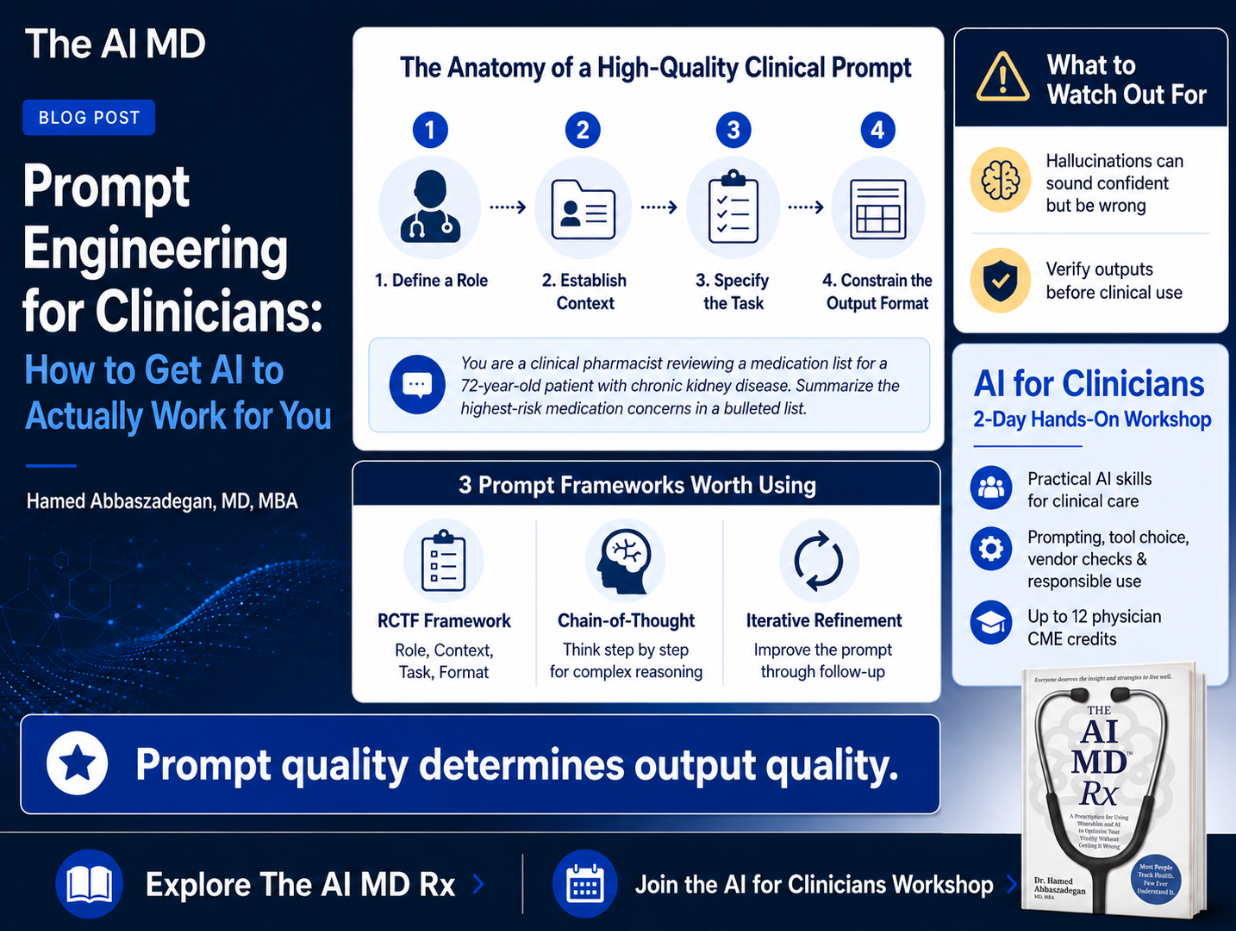
Most people using large language models in healthcare are leaving most of the value on the table. They type a question, read the output, and either accept it or dismiss it. That workflow is somewhat suboptimal — because the quality of what an AI language model produces is almost entirely determined by the quality of what goes in.
Prompt engineering is not a technical skill reserved for data scientists. It is a communication discipline. And for clinicians who already know how to ask precise diagnostic questions, frame differential diagnoses, and communicate complex information to patients — it is a natural extension of what they already do well.
Here is what the evidence shows about constructing prompts that deliver reliable, useful, clinical-grade outputs.
Large language models (LLMs) are prediction engines. They generate responses by predicting the most statistically probable continuation of the input they receive. That means vague input produces vague output. Precise, structured input produces precise, structured output.
Most companies deploying LLMs in healthcare settings are discovering that the bottleneck is not the model — it is the prompt. A well-constructed prompt can transform a generic language model into a useful clinical thinking partner. A poorly constructed prompt produces output that sounds confident but lacks specificity, context, or clinical utility.
The clinician who understands this dynamic stops asking
The clinician who understands this dynamic stops asking "Is this AI good?" and starts asking "Did I give this AI enough to work with?" That is the mindset shift that unlocks real utility.
Effective prompts share four structural elements. They define a role. They establish context. They specify the task. And they constrain the output format.
Define a Role. Telling the model who it is performing as sharpens output quality significantly. "You are a clinical pharmacist reviewing a medication reconciliation list for a 72-year-old patient with chronic kidney disease" produces categorically different output than "check this medication list." The role activates relevant training patterns and orients the model toward a specific domain of expertise.
Establish Context. Clinical decisions are never made in a vacuum. The model needs the same context a consulting colleague would need. Relevant history, current medications, chief complaint, and clinical setting all belong in a well-constructed prompt. More context narrows the possibility space and produces more targeted, useful output.
Specify the Task. Ambiguous tasks produce ambiguous outputs. "Help me with this note" is not a task. "Summarize this patient encounter into a SOAP note format, highlighting the assessment and plan sections, keeping it under 300 words" is a task. Precision drives performance.
Constrain the Output Format. Telling the model exactly what format the output should take — a bulleted list, a structured table, a three-paragraph summary, a differential diagnosis ranked by probability — eliminates unnecessary generation and delivers usable content directly.
The Role-Context-Task-Format (RCTF) framework is the foundational structure for most clinical prompt construction. It covers the essential elements without overcomplicating the process.
The Chain-of-Thought prompt is useful for complex clinical reasoning tasks. Asking the model to "think step by step" before arriving at a conclusion activates more deliberate reasoning pathways and reduces the likelihood of confident-but-wrong outputs. For diagnostic support, differential generation, and treatment planning questions, chain-of-thought prompting consistently outperforms single-step prompts.
The Iterative Refinement approach treats prompting as a conversation rather than a single transaction. The first output becomes the starting point for a follow-up prompt that refines, corrects, or expands. Most clinicians who get strong results from LLMs are not writing perfect first prompts — they are iterating quickly toward precision.
LLMs can generate outputs that sound authoritative but contain factual errors, outdated clinical guidelines, or inappropriate generalizations. This is called hallucination, and it is not a bug that will be fully eliminated — it is a structural characteristic of how these models work.
The mitigation is not to avoid LLMs. It is to verify outputs against authoritative sources before clinical application, to use LLMs for tasks where errors are catchable rather than invisible, and to treat every output as a first draft requiring clinician review rather than a final answer requiring only acceptance.
The clinician who builds prompt engineering into their workflow is not replacing clinical judgment. They are directing AI capability with the precision that clinical judgment provides. That combination accelerates performance without sacrificing safety.
To recap, here are the 3 things worth remembering: Prompt quality determines output quality every time. The RCTF framework (Role, Context, Task, Format) is the fastest path to clinical-grade LLM outputs. And treating prompting as an iterative conversation rather than a one-shot transaction is what separates useful AI interactions from frustrating ones. 🚀




%20(1880%20x%20940%20px)%20(3%20x%204%20in)%20(1).png)


.png)


Stay Connected
If you’d like these insights delivered straight to your inbox, you can sign up below. You’ll receive evidence-based perspectives on AI in healthcare, practical implementation guidance, and updates on speaking engagements and media appearances.