
Hamed Abbaszadegan, MD, MBA

August 4, 2026
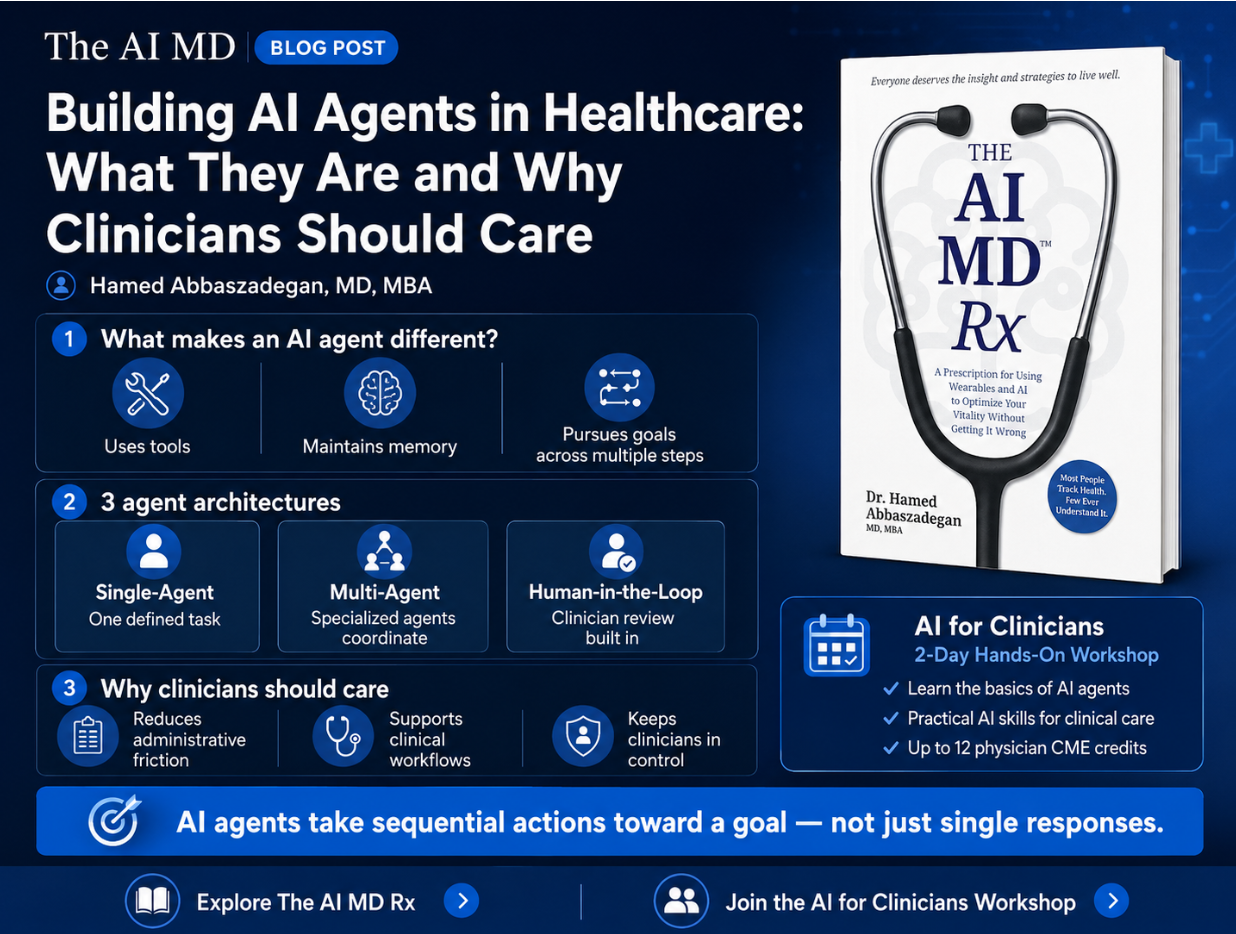
Most discussions about AI in healthcare stop at the tool level. A documentation assistant. A diagnostic support application. A predictive risk score embedded in the EHR. These are valuable. But they represent one layer of what AI systems can do.
AI agents operate differently. They do not simply respond to a single input. They pursue objectives across multiple steps, using tools, memory, and reasoning to complete tasks that would otherwise require sustained human attention. Understanding what agents are and what they can and cannot do is becoming essential knowledge for healthcare professionals who want to operate at the leading edge of clinical AI.
Here is what the evidence shows about AI agents and their emerging role in healthcare environments.
A standard AI interaction looks like this: a clinician inputs a question, the model generates a response, the interaction ends. The model has no memory of previous exchanges, no ability to take external actions, and no mechanism for pursuing a goal across multiple steps.
An AI agent changes that architecture. Agents are AI systems equipped with tools and the ability to search databases, retrieve patient records, execute calculations, send communications, or interact with external software systems. They are also equipped with memory, allowing them to maintain context across extended workflows. Agents operate with goal-directedness, meaning they can break a complex objective into sequential steps and pursue each one autonomously.
The practical implication is significant. A basic Large Language Model answers a question about drug dosing. An AI agent retrieves the patient's current renal function from the EHR, calculates the appropriate dose adjustment, flags the interaction with a concurrent medication, drafts the updated order, and routes it for physician review as a connected, sequential workflow. If you think it is similar to having an assistant or student at your side, you are kind of correct.
Single-Agent Systems complete discrete tasks within defined boundaries. A prior authorization agent that retrieves clinical documentation, matches it against payer criteria, and drafts an authorization letter is an example. Bounded, specific, high-value.
Multi-Agent Systems coordinate multiple specialized agents working in parallel or sequence. A discharge planning workflow might involve a medication reconciliation agent, a social determinants screening agent, and a follow-up scheduling agent each handling a specialized domain while a coordinating agent integrates their outputs into a unified discharge plan.
Human-in-the-Loop Systems build clinician review and approval into the agent workflow at defined checkpoints. This architecture is the most appropriate for high-stakes clinical decisions, where AI handles the information retrieval and synthesis while the clinician retains final decision authority.
Building a basic AI agent does not require a software engineering background. Several platforms allow healthcare professionals to construct simple agents through low-code or no-code interfaces. If you work for a health system however, you would need permissions to deploy such agents in live clinical environments or leverage the platforms already in agreement with your institution.
A practical starting point is a documentation agent: a system that retrieves relevant clinical notes from a patient encounter, synthesizes key information, and drafts a structured summary for a specific purpose such as a referral letter, insurance appeal, care transition handoff. The clinician defines the goal, the tools the agent can access, and the output format. The agent executes the workflow.
The value is not in replacing clinical thinking. It is in eliminating the administrative friction that consumes clinical time without adding clinical value.
AI agents that take actions, not just generate text require the introduction of a governance dimension. When an agent retrieves patient data, routes communications, or triggers downstream clinical workflows, the questions of accountability, auditability, and failure mode management become acute.
Most companies building clinical AI agents are navigating this terrain in real time. The clinician who understands agent architecture is positioned to ask the right governance questions: Who is accountable when an agent makes an error? How are agent actions logged and auditable? What are the failure modes, and how are they monitored?
AI agents are goal-directed systems that take sequential actions, not just generating single responses. Learn more about AI agents and the basics of building one at the AI for Clinicians workshop:
https://www.eventbrite.com/e/ai-for-clinicians-tickets-1988199096017?aff=oddtdtcreator




%20(1880%20x%20940%20px)%20(3%20x%204%20in)%20(1).png)


.png)


Stay Connected
If you’d like these insights delivered straight to your inbox, you can sign up below. You’ll receive evidence-based perspectives on AI in healthcare, practical implementation guidance, and updates on speaking engagements and media appearances.