
Dr. Hamed Abbaszadegan

August 4, 2026
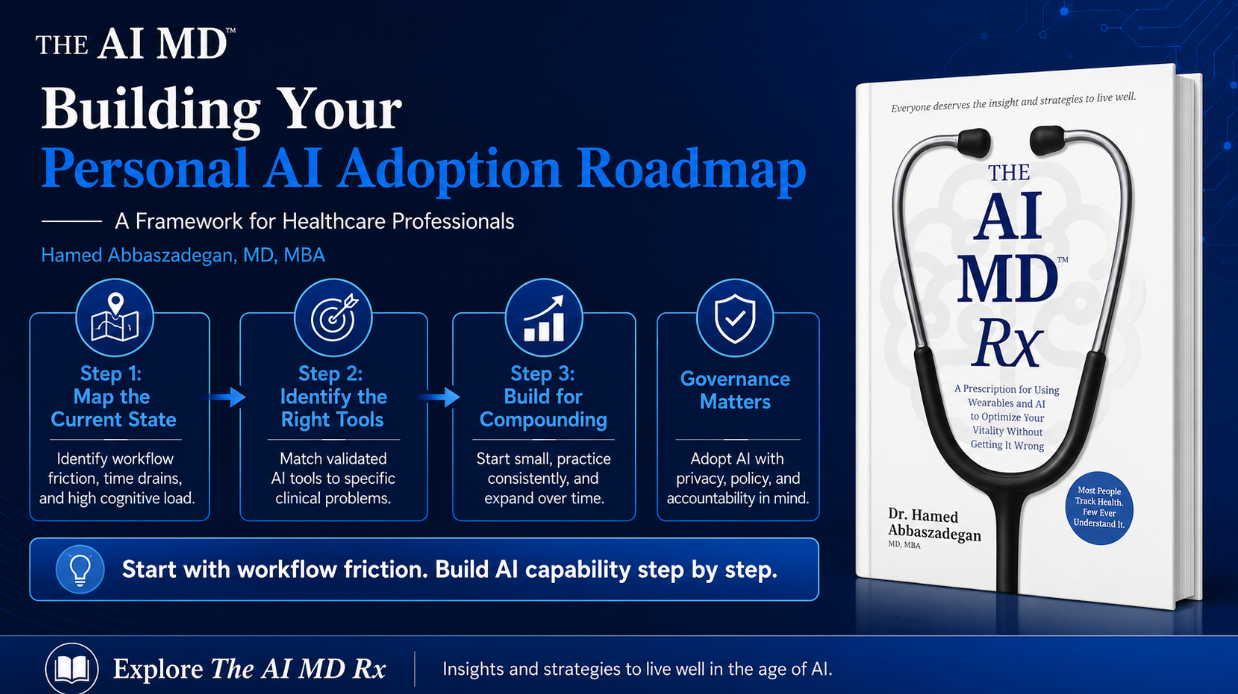
Generic AI adoption advice is everywhere. Frameworks built for technology companies. Playbooks designed for enterprise software rollouts. Enthusiasm-driven listicles promising transformation in 30 days. Almost none of it is calibrated for the specific reality of a healthcare professional trying to integrate AI into a clinical role with real patients, real regulatory constraints, and real institutional environments.
What actually works is a personalized adoption framework one built around the specific clinical context, professional role, and performance goals of the individual clinician. Not AI adoption in theory. AI adoption in practice, for this clinician, in this environment, pursuing these outcomes.
Here is the evidence-based framework for building one.
Before identifying AI tools to adopt, the clinician who builds an effective roadmap starts by mapping the friction in their current workflow. Where does time get consumed without adding clinical value? Where does cognitive load peak? Where do errors or near-misses concentrate? Where does information retrieval slow decision-making?
These friction points are the highest-value targets for AI augmentation. AI adoption that addresses real workflow friction delivers measurable, sustained value. AI adoption driven by enthusiasm for the technology rather than alignment with genuine workflow need delivers short-lived novelty and eventual abandonment.
The current state map does not need to be complex. A simple inventory of daily workflow stages from patient preparation through documentation and follow-up annotated with time expenditure and friction intensity provides enough structure to identify meaningful targets.
Once the friction map exists, tool selection becomes a targeted process rather than a broad exploration. The clinician is no longer asking "what AI tools are available?" They are asking "what AI tools address the specific friction points I have identified in my specific clinical environment?"
Applying the evaluation framework training data, validation methodology, failure modes, distributional shift, regulatory status to the shortlisted tools ensures that adoption decisions are grounded in evidence rather than marketing. The goal is not to adopt the most impressive technology. It is to adopt the technology that performs reliably on the specific problem it is being deployed to solve.
Starting with one or two high-confidence, narrow-scope tools rather than broad AI platform adoption is the approach most likely to generate early wins, build institutional trust, and create the feedback loops needed to expand adoption intelligently.
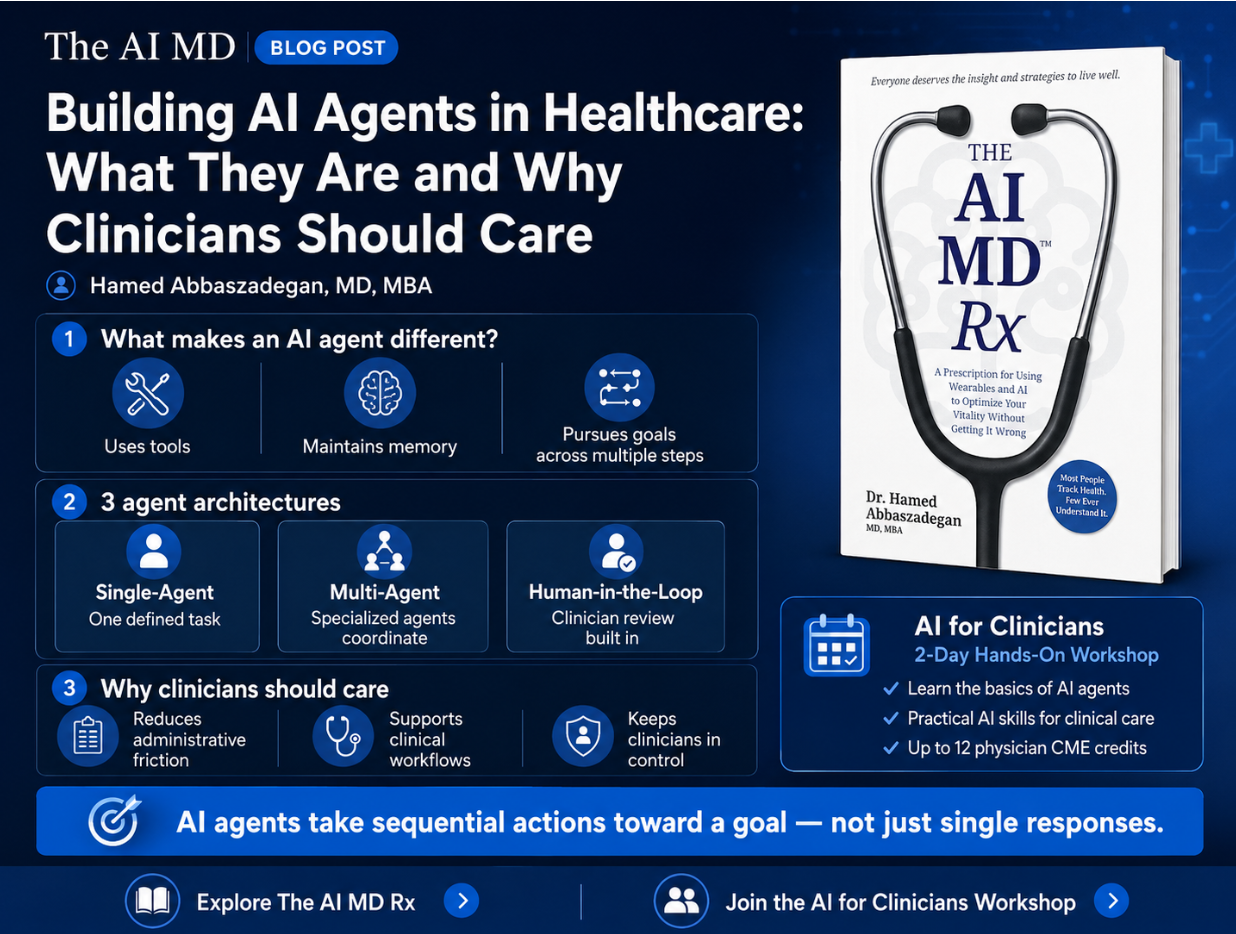
AI adoption is not a destination. It is a compounding practice. The clinician who starts with a documentation assistant, develops fluency with prompt engineering, and builds feedback loops into their AI interactions is positioned to add more sophisticated tools (including agent-based systems) over time.
The compounding principle applies to organizational adoption as well. Individual clinician fluency becomes department-level capability. Department-level capability becomes institutional infrastructure. The clinician who builds personal AI literacy early contributes to organizational transformation that scales far beyond their own practice.
Incremental, consistent engagement with AI tools even 15 minutes of deliberate practice per week compounds into significant capability advantage over 12 months. The data on skill acquisition is consistent: distributed practice outperforms concentrated crash courses every time.
An individual AI adoption roadmap is incomplete without a governance dimension. The clinician who adopts AI tools within their practice has an obligation to understand the institutional policies governing that adoption, the privacy implications of the tools they are using, and the accountability framework within which their AI-augmented decisions operate.
This is not a bureaucratic obligation. It is a clinical one. The same rigor applied to adopting a new clinical procedure understanding the evidence, the risks, the failure modes, and the accountability structure applies to adopting an AI clinical tool.
To recap, here are the 3 things worth remembering: Effective AI adoption starts with a current-state friction map, not a technology wish list. Tool selection driven by specific, validated problem-solution fit outperforms enthusiasm-driven broad adoption every time. And building AI literacy as a compounding practice incrementally, consistently, over time is the strategy that separates the clinician who transforms their practice from the one who tries a few tools and returns to the status quo. 🗺️




%20(1880%20x%20940%20px)%20(3%20x%204%20in)%20(1).png)



.png)



Stay Connected
If you’d like these insights delivered straight to your inbox, you can sign up below. You’ll receive evidence-based perspectives on AI in healthcare, practical implementation guidance, and updates on speaking engagements and media appearances.