
Hamed Abbaszadegan, MD, MBA

August 4, 2026
%20(1880%20x%20940%20px)%20(3%20x%204%20in)%20(1).png)
Most healthcare professionals are operating in an AI environment they did not train for. The landscape shifted faster than the curriculum. And the gap between what clinicians know about AI and what AI is already doing in their clinical environment is widening every quarter.
That is not a criticism. It is a structural reality. Medical education was not designed to keep pace with exponential technology cycles. The question worth asking is not whether AI belongs in healthcare. It is already there. The real question is whether clinicians are equipped to work with it, evaluate it, and shape it?
Here is what the evidence shows about where AI currently stands — and why it matters for daily practice.
Clinical AI is not a future-state conversation. Radiology departments deploy AI-assisted image analysis tools that flag anomalies before a radiologist opens the file. Emergency departments use predictive algorithms to triage patient risk. Electronic health record systems generate clinical documentation suggestions in real time. Pharmacy systems flag drug interactions through machine learning models trained on millions of patient records.
Most companies in health technology are not asking whether to implement AI. They are asking how fast they can scale it. That acceleration creates both opportunity and risk for the clinician at the point of care.
The opportunity: AI can accelerate pattern recognition, surface relevant clinical data, and reduce cognitive load in high-stakes environments. The risk: AI can also embed bias, generate plausible but incorrect outputs, and erode clinical judgment when used without appropriate critical evaluation. How you prepare yourself to leverage AI in clinical setting is becoming a key differentiator amongst clinicians.
Navigating the AI landscape effectively requires understanding it across three distinct layers.
The Tool Layer. These are the AI applications clinicians interact with directly such as documentation assistants, diagnostic support tools, scheduling optimizers, and patient communication platforms. Most clinicians encounter AI here first. The critical skill at this layer is evaluation: understanding what the tool does, what data it was trained on, and what its failure modes look like. Creating a critical eye to trust yet verify becomes key, just as what was taught in clinical training.
The Infrastructure Layer. This is the data architecture beneath the tools. EHR systems, data lakes, interoperability frameworks, and the governance structures that determine how patient data flows and who controls it. Clinicians rarely see this layer directly, but it determines the quality and reliability of every AI output they encounter. It is important to question such architecture before these tools are deployed at an enterprise level.
The Governance Layer. This is where policy, ethics, regulation, and accountability live. FDA clearance pathways for AI-based medical devices, HIPAA implications for AI-generated documentation, and institutional policies for AI deployment all exist at this layer. Understanding it protects both the patient and the clinician. How governance is set up in your practice or institution will dictate the safe applications of AI for clinical settings.
AI systems excel at tasks with high data volume, clear pattern structure, and defined outcome metrics. Image classification, risk stratification, medication reconciliation, and appointment no-show prediction are domains where AI consistently demonstrates measurable value.
AI systems struggle with tasks requiring contextual nuance, ethical judgment, patient relationship dynamics, and novel clinical presentations that fall outside training data distributions. The clinician who understands these boundaries uses AI as an accelerant for what it does well and maintains rigorous oversight where it does not.
The data suggests that the most significant performance gains in clinical AI come not from replacing clinician judgment but from augmenting it at precisely the right moments. The key word is augmenting. Not automating. Not replacing. Augmenting. When you understand this in a deep capacity, you embrace AI, not fear it.
For the clinician who sees patients on Tuesday morning, this translates into three concrete shifts.
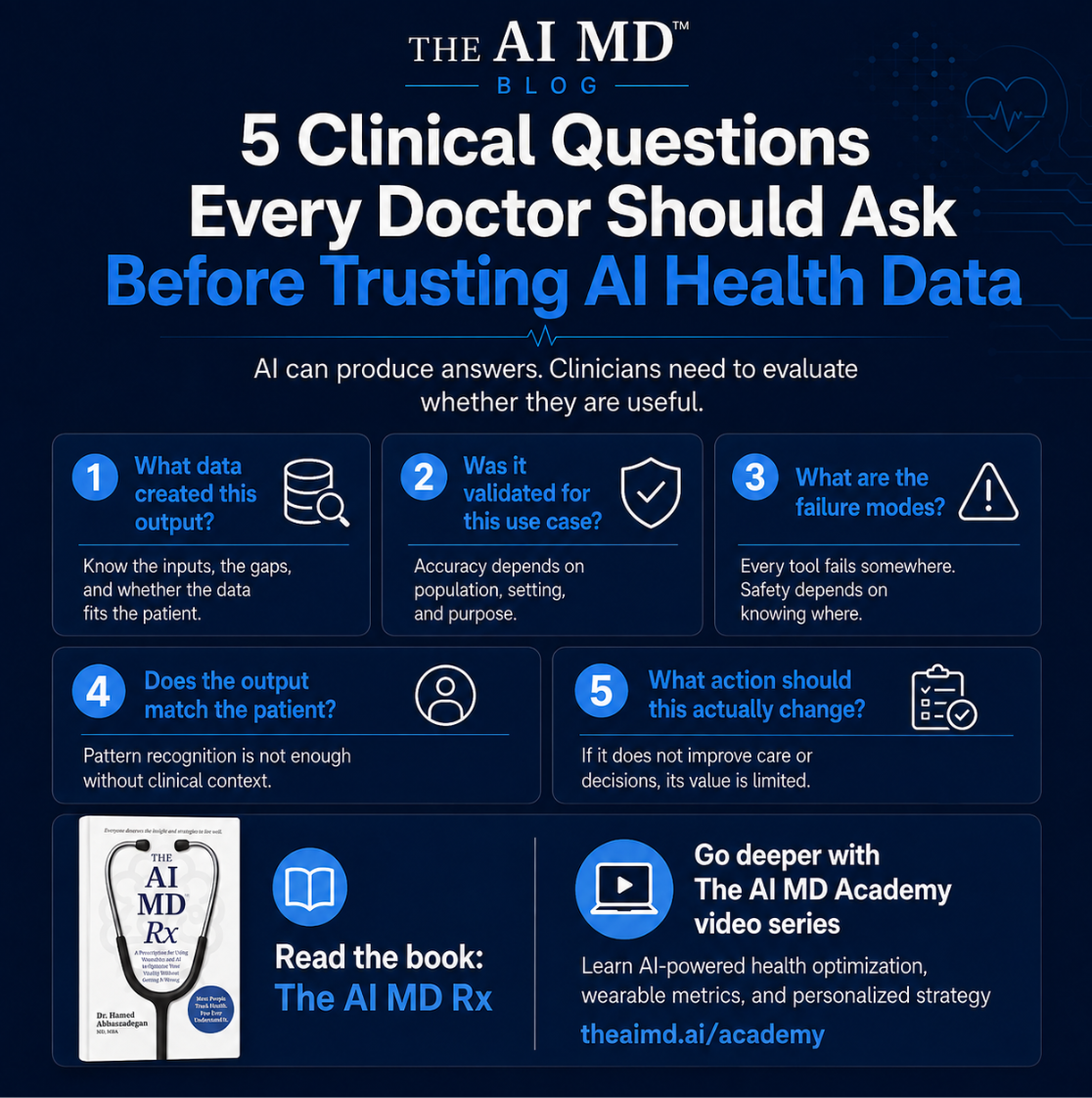
First, every AI-generated output encountered in clinical workflow deserves a moment of critical evaluation not paralysis, but active interrogation. Where did this recommendation come from? What was it trained on? Does it match the patient in front of me? These simple cognitive thoughts will shape your clinical day. You already have the judgement built into your thinking, applying it with AI is also critical. No blind trusting!
Second, staying current with AI developments in one's specialty is now a professional competency, not an optional interest. The clinician who understands the AI tools in their environment makes better decisions with them and catches errors others miss.
Third, clinician voices need to be present in AI governance conversations at the institutional level. The people closest to the point of care are the ones best positioned to identify where AI creates value and where it introduces risk. That voice belongs in the room.
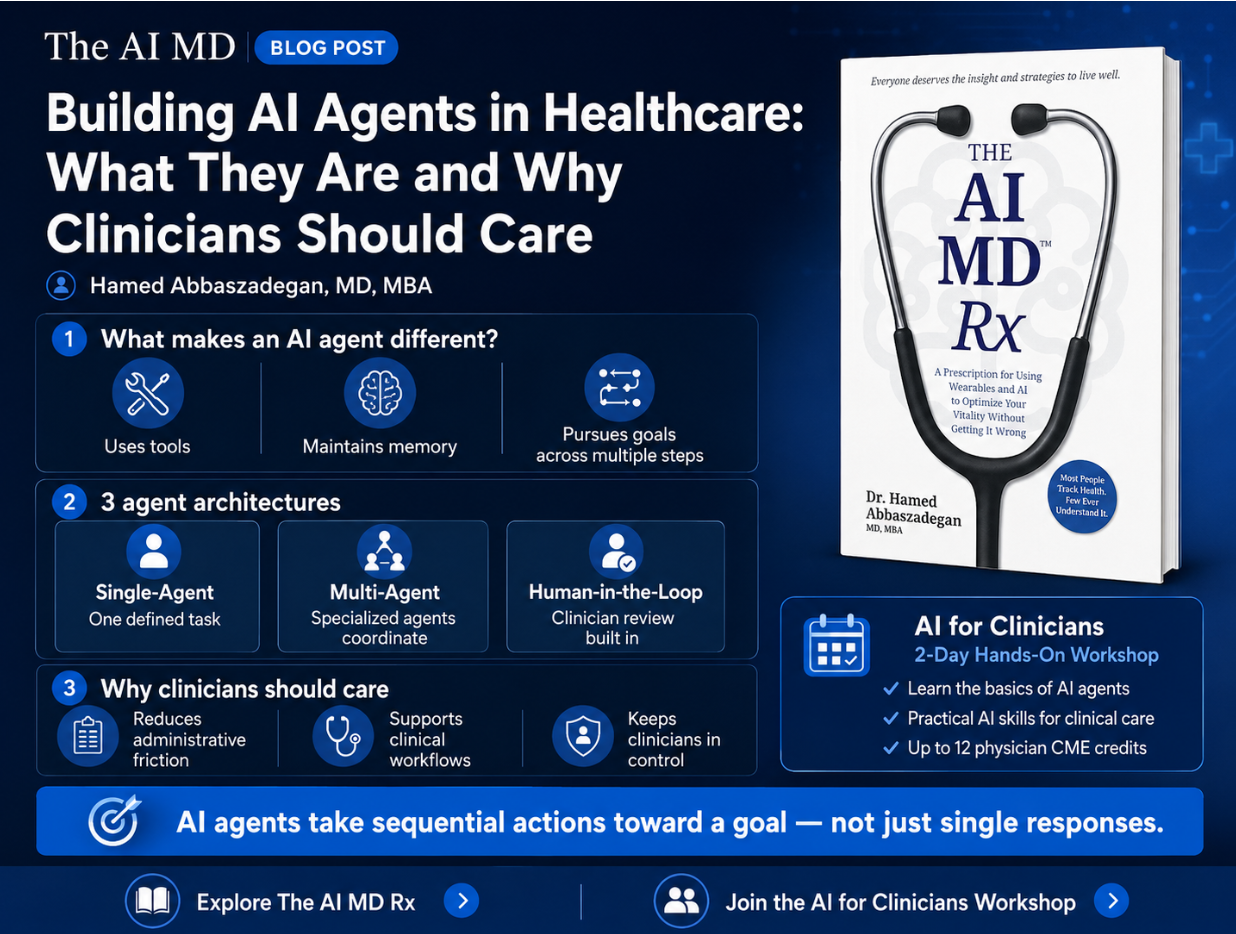
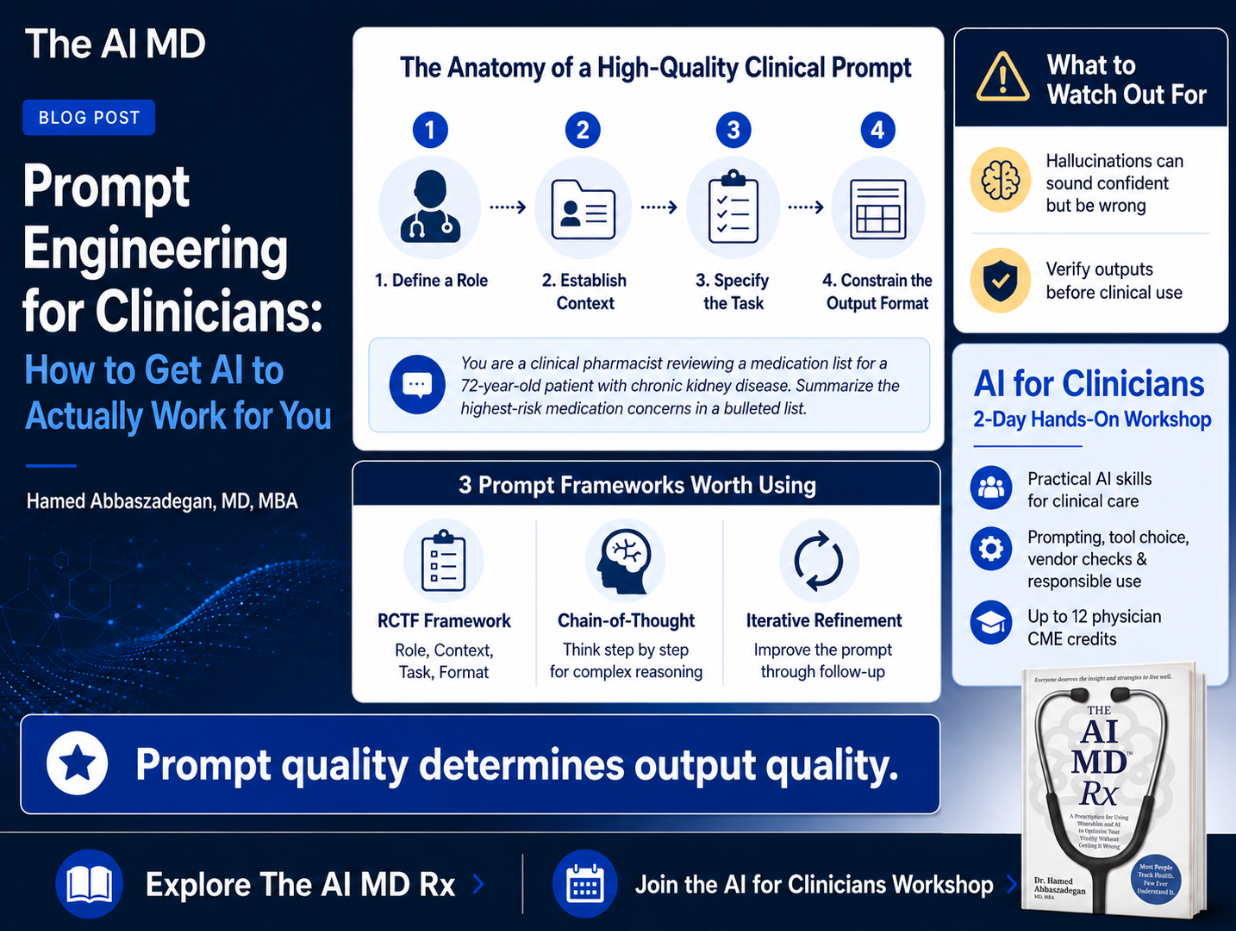
AI is not a threat to clinical expertise. It is a force multiplier for clinicians who understand how to use it, evaluate it, and govern it responsibly. Learn more depth on AI for clinical care at the AI for Clinicians workshop:
https://www.eventbrite.com/e/ai-for-clinicians-tickets-1988199096017?aff=oddtdtcreator







.png)


Stay Connected
If you’d like these insights delivered straight to your inbox, you can sign up below. You’ll receive evidence-based perspectives on AI in healthcare, practical implementation guidance, and updates on speaking engagements and media appearances.