
Dr. Hamed Abbaszadegan

August 4, 2026
The enthusiasm around AI in healthcare is justified. The potential is real. The documented benefits in specific clinical domains are measurable. But the deployment of AI in clinical environments introduces ethical, legal, and privacy dimensions that cannot be addressed after implementation. They must be built into the foundation.
Most companies racing to deploy healthcare AI are moving faster than the governance frameworks designed to contain the risk. The clinician who understands these dimensions is not a barrier to innovation. They are the safeguard that makes sustainable innovation possible.
Here is what every healthcare professional needs to understand about the ethical, legal, and privacy landscape of clinical AI.
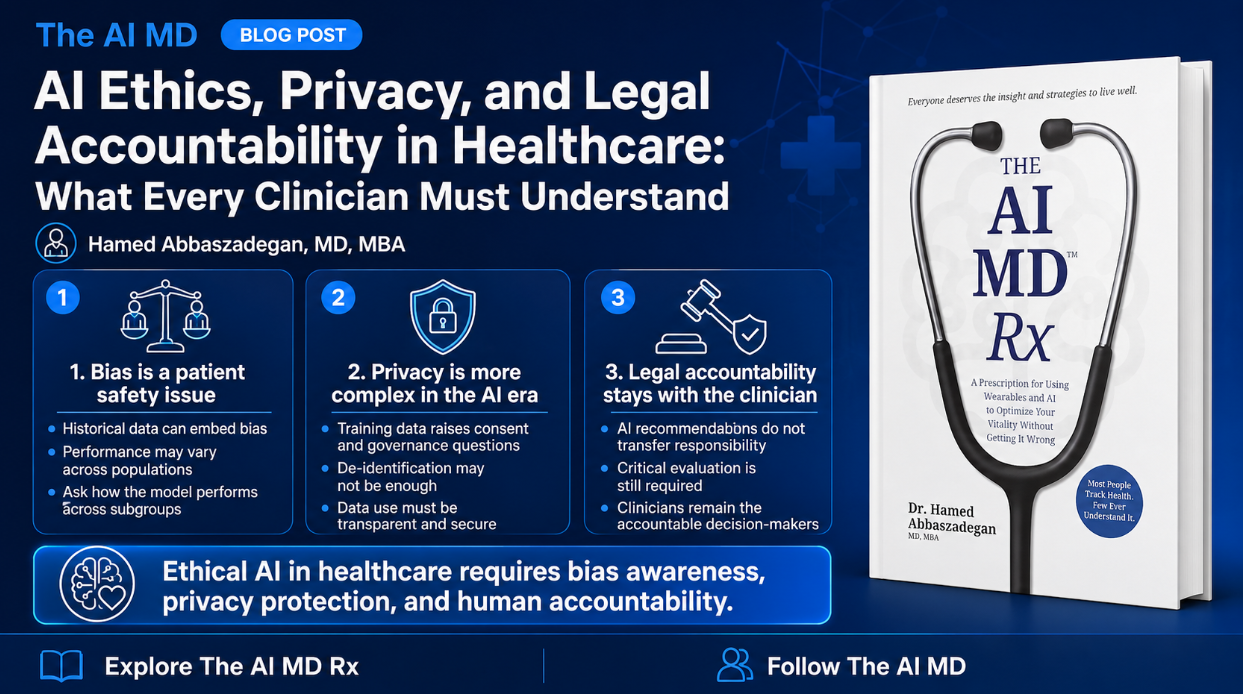
AI systems trained on historical healthcare data inherit the biases embedded in that data. Those biases are not subtle. A widely studied commercial algorithm used to allocate healthcare resources was found to assign significantly lower risk scores to Black patients than to White patients with equivalent health needs. The study showed this happened because it used healthcare utilization as a proxy for health need. Furthermore, historical utilization patterns reflected systemic access disparities rather than actual clinical need.
This is not an isolated case. Dermatology AI tools trained predominantly on lighter skin tones demonstrate measurable performance degradation on darker skin tones. Cardiac risk algorithms calibrated on male patient populations underperform when applied to female patients. Diagnostic AI tools validated in academic medical centers show performance gaps in underserved community health settings.
Algorithmic bias is a patient safety issue. The clinician who understands this is equipped to ask the right questions before a biased tool reaches the point of care.
HIPAA established the foundational framework for patient data privacy in US healthcare. AI introduces new complexity to that framework that existing regulation was not designed to address.
When patient data is used to train AI models, questions of consent, data governance, and secondary use arise. Most patients whose data contributed to training a commercial AI diagnostic tool did not explicitly consent to that use. Most institutional data sharing agreements governing AI development were not written with sufficient specificity to cover the full range of AI applications they now enable.
De-identification — the standard HIPAA mechanism for enabling research data use is increasingly insufficient as a privacy protection in AI contexts. Research demonstrates that AI systems can re-identify individuals from datasets that meet standard de-identification criteria, using auxiliary data sources and pattern recognition techniques unavailable when those criteria were established.
When an AI system contributes to a clinical error a missed diagnosis, an inappropriate medication recommendation, a delayed deterioration alert the question of legal accountability is not settled. Current legal frameworks were not designed for AI-mediated clinical decisions.
Several accountability models are under active discussion. Developer liability frameworks hold AI vendors accountable for tool performance failures. Institutional liability frameworks hold health systems accountable for deployment and oversight decisions. Clinician liability frameworks hold the treating clinician accountable as the final decision authority, regardless of AI input.
The most practically relevant implication for the clinician today is this: AI-generated recommendations do not transfer clinical responsibility. The clinician who accepts an AI recommendation without critical evaluation is not protected by the existence of the AI. They remain the accountable decision-maker. That accountability is both the appropriate standard and the professional reality.
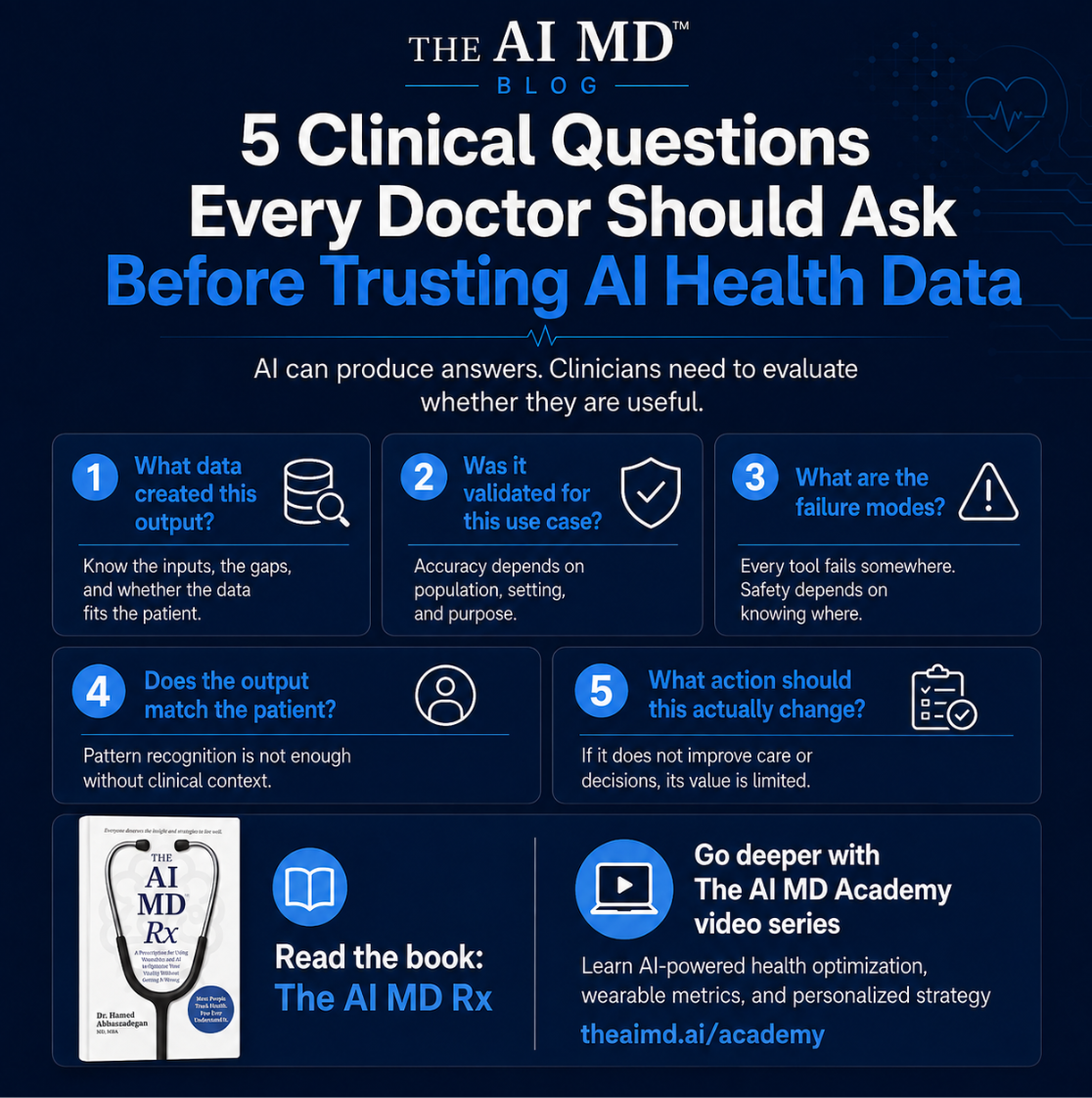
Ethics in clinical AI is not only an institutional responsibility. It operates at the individual clinician level as well. Asking whether an AI tool performs equitably across the patient population served. Flagging performance anomalies that may indicate bias. Advocating for transparency in how AI recommendations are generated. Maintaining informed consent conversations that include the role of AI in clinical decision-making. These are not bureaucratic obligations, they are clinical ones.
To recap, here are the 3 things worth remembering: Algorithmic bias is a patient safety issue with documented, measurable clinical consequences. Privacy frameworks designed for pre-AI healthcare are insufficient for the data governance challenges AI deployment introduces. And clinical responsibility does not transfer to the AI the clinician remains the accountable decision-maker, regardless of what the algorithm recommends. ⚖️




%20(1880%20x%20940%20px)%20(3%20x%204%20in)%20(1).png)



.png)



Stay Connected
If you’d like these insights delivered straight to your inbox, you can sign up below. You’ll receive evidence-based perspectives on AI in healthcare, practical implementation guidance, and updates on speaking engagements and media appearances.